Rethinking Work: A Reintroduction.
The Future Does Not Fit in the Containers of the Past. Edition 314.

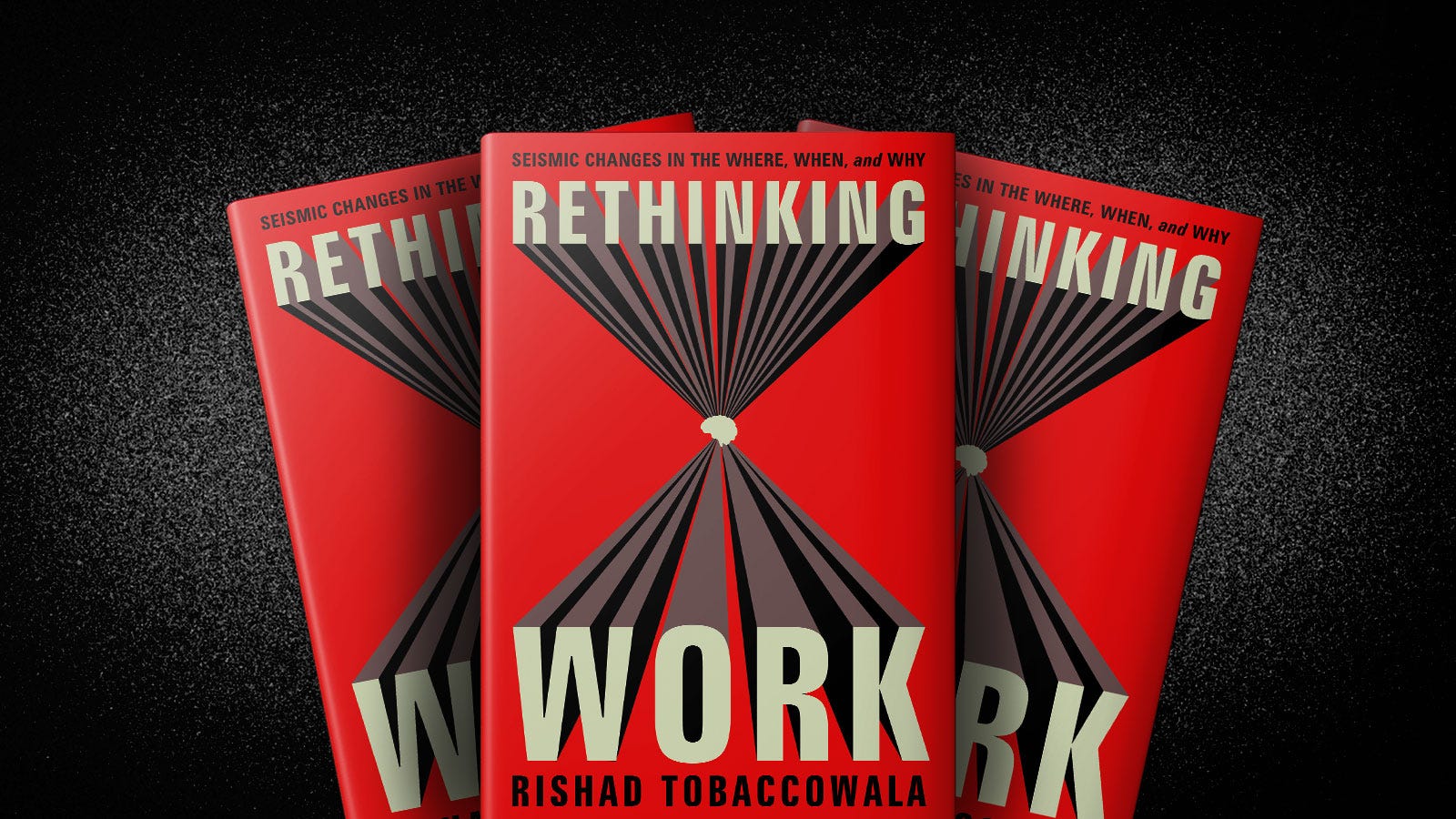
Over 3 years ago, as my agent was shopping the manuscript of “Rethinking Work” he first approached HarperCollins who had published my first very successful book, Restoring the Soul of Business: Staying Human in an Age of Data, because they had the first right of refusal on my next book.
Despite the financial success of the first book and even though though the acquiring editor wanted to offer an advance, HarperCollins passed. The acquiring editor explained that the new Publisher ( my original publisher had left for academia) believed I was not writing a book of business but a book of science fiction!
She wondered why I was making a big deal about AI ( this was just before ChatGPT), and questioned my belief that work would change more between 2020 and 2029 than in the next fifty years requiring completely new ways of working, an era of “de-bossification” and dramatically different organizational structures.
A week later McGraw-Hill bought the book and paid an advance.
A few months into writing the book a major strategic change at McGraw-Hill led them to decide to focus only on text and educational books and withdraw from business book publishing. They gave back the book rights and let me keep the advance.
Within 48 hours HarperCollins purchased it.
The launch of ChatGPT and the departure of the sceptical publisher allowed my acquiring editor to buy the book as he had always wanted to.
Rethinking Work has proven to be both prescient and highly actionable.
Every single thing predicted has happened or is about to happen.
A few months ago Fidelity Investments had many of their leaders read the book and then had me participate in a work session with them. One of the questions I was asked was given the year since the book had been published what I may have got wrong.
The speed of change. The future of work is even faster than anticipated and the last section of the book which I believed would happen by 2029 will happen in 2027.
As a result this book is probably more relevant now than when it was published and so I am sharing most of the Introduction ( which was written 2 years ago) for those who want a cliff-notes version.
A. Five Interlocking Forces Sculpting the Future of Work.
FORCE ONE—Generational Shifts: For the first time, four and possibly five generations will work in the same firms. The youngest employees in their twenties are Gen Zers, and they are about to become the largest component of the workforce. The eldest employees are baby boomers, the youngest of whom are turning sixty, and they have dominated the workplace in numbers, income, and impact until now. In between are millennials and Gen X. The mindsets, expectations, and worldviews of each group are significantly different. In addition to the rise of Gen Z, we are seeing a rapid aging of the workforce and declining population growth.
FORCE TWO—Technology: We are entering an AI-infused age when the cost of knowledge may soon be zero. More than half of the workforce in high-income countries are knowledge workers. Imagine the implications when this new AI reality become prevalent. Every job will be changed. How many will be lost and what new careers will be forged?
FORCE THREE—Marketplaces: Today hundreds of market-places such as Upwork allow talent to be procured from anywhere. Etsy and Shopify allow individuals to access customers from everywhere. App stores and cloud services from Apple, Amazon, Google, Microsoft, and OpenAI allow small and medium firms to access billion-dollar tech.
FORCE FOUR—New Ways of Working: Demographics, technology, and marketplaces are now enabling vastly different ways of working, which is giving rise to a world of side hustles and side gigs.
FORCE FIVE—The Long-Term Impact of COVID: COVID is just one of the five factors creating seismic change at work, and its biggest impact may not be on where people work but on the emotional rewiring it caused when, during the pandemic’s nearly three years, people reconsidered the role of work in their lives.
Consider a few statistics:
By 2027, 86.5 million people, or half the workforce, will be doing some freelance work.
In 2022, more than one-third of US workers and two-thirds of those under age thirty juggled different “gigs” (rather than work full time at one job). The “fractionalized” employee (my term) is becoming a reality.
According to research conducted by the McKinsey consulting firm, 80 percent of people who worked at home during COVID liked it, and 41 percent asserted they were more productive than they were working from the office. Fifty-nine percent of respondents (in a study conducted by Owl Labs) said they would be more likely to choose an employer that offered remote work over companies that didn’t.
But the need to rethink work goes beyond even these statistics about remote work and the shift from full-time to part-time and gig jobs. For instance, people used to work primarily for income and achievement. While these factors are still important, we’re seeing a growing number of people choosing jobs based on meaning (the work is fulfilling, satisfying them on a deeper level), community (connection with like-minded people), and social purpose. Millennials and Gen Zers, especially, are searching for work experiences that fit their personal beliefs and styles
The Who, What, Why, Where, When and How of Rethinking Work.
WHO WILL PEOPLE WORK FOR? Until recently, most people worked for someone else for a relatively long period of time—a large corporation, the government, an educational institution, and so on. But communication technology advances, new business models.and marketplaces, and changing generational mindsets are transferring power to the individual. This transfer gives people work options, and they’re exercising them in all sorts of ways. For instance, a growing number of individuals are choosing to work for themselves. Zoom, Slack, and other platforms facilitate work processes; Etsy, Shopify, and Substack help users leverage their capabilities and scale themselves and their ideas to growing markets. Others are opting for greater control over whom they work for. Digital natives have lived through 9/11, the Great Recession, and. COVID, and their attitudes have changed—they believe much more in themselves than in organizations. As a result, people are rejecting the old model of working for one organization for a decade or longer. Instead, they’re choosing to be gig workers, to create start-ups, to become fractionalized employees, to dedicate themselves to and work for a cause. To mix and match employers. Just as employees have numerous options, so too do organizations. This book will help leaders capture talent by structuring jobs in ways that appeal to this new work sensibility.
WHAT WILL ORGANIZATIONS LOOK LIKE? Like nothing in the past. We will no longer have a single organizational model or design but instead have a wide range of operating styles, structures, and sizes. In the past, organizational models were like classical music, with a conductor, orchestra, and well-rehearsed score. In the future, they will be like jazz, involving different players who take the music in surprising, unpredictable directions. Companies will be fluid, forming and reforming themselves to fit the market and emerging needs. They’ll mix full-time and part-time workers, in-office and remote employees, teams and individual performers; they’ll shift alliances continuously, collaborating with a range of suppliers, consultants, and others as need dictates.
WHY WILL PEOPLE WORK? People have always worked for a variety of reasons—income, identity, community, social purpose, and personal meaning. As noted earlier, COVID and shifting social norms are causing more people to choose jobs and careers based on factors other than income. Empowering technologies also make it easier for people to pursue meaningful work. But another trend has a profound effect on why. In the past, one full-time job rarely satisfied all our reasons for working. The law firm partner was well paid but found little personal satisfaction in his job. Or the social worker found satisfaction in helping others, but she was micromanaged, hampering her personal work style. Today, however, we’re seeing a shift to people satisfying all or most of their whys by having more than one job—two-thirds of those under age thirty are combining different gigs. A mix of roles—side hustles, volunteer positions, and so on—is much better able to satisfy all our work requirements than a single job can.
WHERE WILL PEOPLE WORK? In the metaverse. At home. In morphing offices that will bear little resemblance to traditional places of business. In planes. And perhaps in the not-so-distant future, in self-driving cars. According to a Stanford University study, “Compared to 2019 levels, employees’ average distance from their home to their employer has risen 2.7 times: The mean distance to work rose from ten miles in 2019 to twenty-seven miles at the end of 2023. The share of workers living more than fifty miles from their employer rose more than five-fold.” COVID certainly has powered this trend, but so too has our entering the Third Age of the Internet—AI, 5G, the metaverse, blockchain, cryptocurrency, and other developments are reshaping industries and companies. US companies have formed alliances with organizations in India, China, Brazil, Russia, Vietnam, and elsewhere; people work virtually and sometimes physically far from home, and they will do even more of this in the future. It’s not just that people are working remotely. It’s that they are working on teams with members from seven different countries, and that their customers and suppliers are located on different continents. In the future, being a global company isn’t just a description of office locations but of a mindset—we are becoming workers of the world. To answer this “where” question, I’ll offer advice about how to maximize flexible workspaces, creating policies and cultures that cater to locational agility.
WHEN WILL PEOPLE WORK? Whenever. The nine-to-five day has long since passed. Until recently, work was confined to certain days and hours because of rigid structures—we all needed to work together in the same place for efficiency, for people to be managed properly. Now we require temporal flexibility for many reasons. Most obviously, if we’re doing business with people on the other side of the world, the time zones are different. Less obviously, efficiency is less important than innovation, disruption, and agility. These qualities are less likely to emerge if we confine our work to rigid schedules. Great ideas surface in the middle of the night, when we’re exercising, when we become inspired by a piece of music at the symphony. We need to feel empowered to call, text, or email our colleagues to obtain their feedback and ideas at this moment of inspiration. This doesn’t mean that we become 24/7 workaholics. Instead, our work hours become fluid, dictated by work projects, time frames, and our own preferences—we might need to take time off to recharge in the middle of the traditional workday, and we might need to meet virtually with colleagues at midnight.
HOW WILL LEADERSHIP CHANGE? We are witnessing the decline of the manager and the rise of a new type of leader. In the past, the managerial role was essential to efficient organizational operation—they managed by walking around and checking in on their people. In an increasingly distributed world where people often work virtually, you can’t manage by walking around. Younger generations, especially, hate being monitored. While employees used to rely on managers for news and expertise, they can now use YouTube, Khan Academy, Open AI, and other online tools to learn what they need to know. Managers, therefore, are becoming anachronisms, while a new type of leader is becoming crucial for organizational success. This type of leader displays three traits: a growth mindset (growing people and businesses, macro-imagining possibilities rather than micromanaging employees); improvisation skills (the agility to pivot on a dime); and a thirst for learning (in a world of rapid change, continuous learning is the only way to survive).
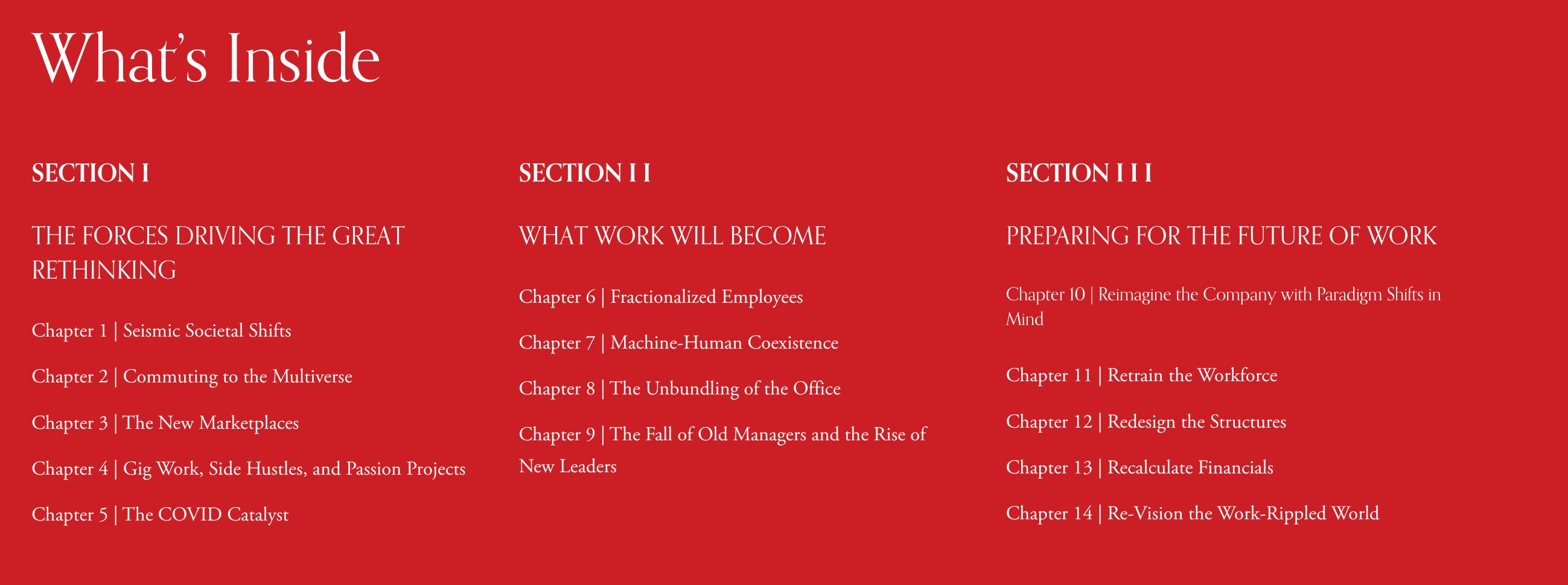
This book is divided into three sections. The first section examines why we need to rethink work—the factors that are causing traditional structures and styles to be ineffective. The second section analyzes the ways in which work needs to be rethought. The third section addresses what we can do about it—the steps that organizations can take to change themselves so they’ll be prepared for the Great Rethinking.
This book is for everybody who works, whether you are a longtime senior leader or a brand-new employee, whether you work in a large company or for yourself, and whether you work in a developed or developing market.
Work is central to our lives and as it gets redefined, nothing is as important as being informed and provided with tools to thrive in the coming transformation.
The book is available in physical, digital and audio formats in the US, parts of Europe and India. Will be published in October in Brazil. Many options to buy across formats and from big to independent stores here.
Any chapter can be read in any order:
One Single Thing.
On one of the two main stages at SXSW (South by SouthWest) an editor of Fortune Magazine interviewed me on how one can navigate the future of work. Listen to the first five minutes and you will never thing about work, your company or your job the same way ever again:
I still see the need for a role in leadership that’s more about teams, on top of the traits you lay out. The traits are essential for continual innovation and growth. I've held onto and keep testing a set of skills that leaders need to have to build effective teams: Driving alignment, building trust and unlocking the potential in people. Both seem important.
One man’s educated opinion is still one man’s opinion, “educated,” or not. There is absolutely no way to correctly foretell the future. It is only after “the future” has played out and those who guessed accurately will have been promoted as brilliant for doing so.